
Residential, Commercial, and Mixed-Use Developments:
Understanding Asset Typologies in Egypt’s Evolving Urban Landscape
An Institutional Perspective from NAD Developments
Egypt’s real estate landscape has evolved beyond single-use developments. As urban centers expand and infrastructure matures, the distinction between residential, commercial, and mixed-use assets has become a defining factor in long-term urban performance.
Each asset typology serves a distinct role within the city’s structure. Understanding these roles is essential for evaluating how developments contribute to liquidity, operational sustainability, and long-term value creation.
From an institutional standpoint, asset selection is not driven by short-term yield comparison, but by alignment with location, infrastructure readiness, and long-term demand fundamentals.
Residential Assets: The Foundation of Urban Stability
Residential development remains the structural backbone of Egypt’s real estate market. Sustained population growth and expanding metropolitan areas continue to drive consistent demand for housing in established districts.
Well-planned residential assets perform best in locations supported by mature infrastructure, access to education and healthcare, and integrated community services. In such environments, residential developments provide stability, long-term occupancy, and resilience across market cycles.
Residential assets are therefore positioned as long-horizon components of urban continuity rather than vehicles for rapid turnover.
Commercial Assets: Anchors of Economic Activity
Commercial developments including offices, retail, and medical facilities play a critical role in shaping economic density and employment hubs. Their performance is closely tied to accessibility, surrounding population, and integration within larger urban systems.
In emerging business districts and fourth-generation cities, institutional-grade commercial assets provide extended leasing cycles and operational predictability when supported by disciplined planning and execution.
From a development perspective, commercial assets require higher levels of governance, technical coordination, and delivery credibility to ensure long-term functionality and sustained occupancy.
Mixed-Use Developments: Integrated Urban Environments
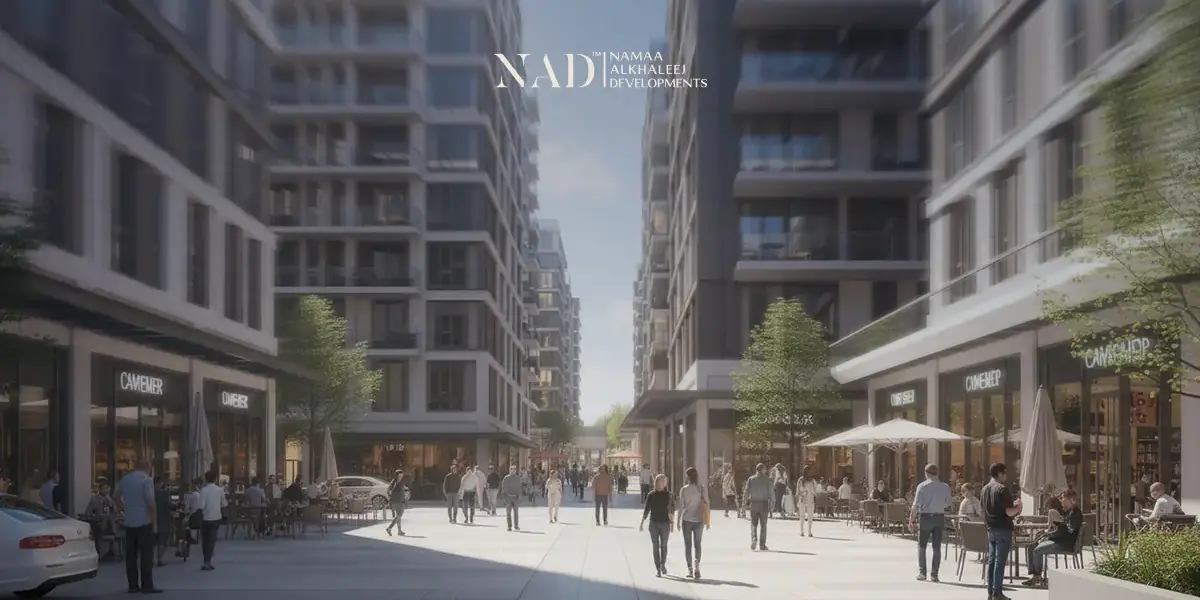
Mixed-use developments represent a structural shift in how modern cities function. By combining residential, commercial, and service components within a single destination, mixed-use assets support continuity of activity and operational efficiency.
When planned correctly, mixed-use environments enhance accessibility, reduce reliance on single-use demand cycles, and reinforce asset relevance over time. Their success depends on balanced zoning, circulation clarity, and disciplined operational management.
Institutional developers approach mixed-use not as a collection of components, but as an integrated urban system.
Asset Typology and Location Alignment
No asset typology performs in isolation. Long-term success is determined by alignment between:
- Location maturity
- Infrastructure readiness
- Surrounding demand drivers
- Development execution discipline
Residential assets perform best in established communities with stable population demand. Commercial assets are strengthened by proximity to employment corridors and service clusters. Mixed-use developments deliver their greatest value in emerging hubs where integration and density are essential. At an institutional level, typology decisions are contextual , not comparative.
Developer Discipline as a Determining Factor
Regardless of asset type, long-term performance depends heavily on development discipline. Governance, delivery credibility, and operational foresight significantly influence asset sustainability.
Well-executed developments in secondary locations may outperform poorly delivered projects in prime areas. Institutional development therefore prioritizes execution quality as much as asset selection.
Conclusion: Assets as Part of the City, Not Products
Residential, commercial, and mixed-use developments each play a distinct role in shaping Egypt’s urban future. Their value is realized not through short-term performance metrics, but through long-term relevance, operational continuity, and integration within the city fabric.
At NAD Developments, asset typologies are approached as components of a larger urban vision planned with precision, delivered with discipline, and designed to endure.
Where Vision Becomes Legacy.